Weekly Picks

11 Kisses

Lovecraft Locker Update

Five Nights in Anime 4

Lovecraft Locker Full Version

SAKURA School Simulator

Lovecraft Locker 2
Omori Bad End

Lovecraft Locker
High School Simulator

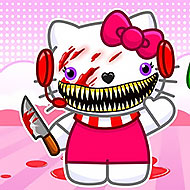
The flashlight in Hello Kitty [HORROR] does not work the way most horror games train you to expect, since the same beam that reveals hidden items also draws certain threats straight toward you, turning a basic survival tool into a constant risk calculation.
| Genre | Psychological Survival Horror |
| Setting | Corrupted landmarks including a toy factory, candy garden, and tea room |
| Core Mechanic | Sound-based detection and limited-battery exploration |
| Known For | Quiet tension over jump-scare frequency |
Each level reimagines a familiar location as a fractured memory rather than a straightforward haunted house. The toy factory, the candy garden, and the tea room all carry recognizable shapes from the source material, but every one of them has been twisted into something that no longer behaves the way it should, and that dissonance between what a space looks like and what it actually does is a big part of what unsettles players early on.
Corrupted versions of Hello Kitty and her friends stalk, trap, or manipulate you depending on the decisions you make while exploring, which means two players can walk through the same tea room and come away with very different close calls. Beginners often underestimate how quickly Hello Kitty closes distance once alerted, and walking instead of sprinting is frequently safer, since noise directly affects how fast she locates you, a mechanic plenty of new players ignore until it costs them a run.
Community players use the term noise discipline to describe limiting movement sounds and unnecessary actions that alert Hello Kitty, and ignoring that discipline is the single most common way beginners trigger encounters that were easy to avoid. Flashlight use compounds the problem, since batteries drain quickly, often lasting only a few minutes of continuous use, and darkness doesn’t just limit visibility, it increases encounter risk by cutting off your ability to track where Hello Kitty actually is.
Closets and spaces under furniture provide temporary safety, but staying hidden too long creates predictable patterns that Hello Kitty can exploit, which surprises players who assume hiding guarantees survival. Experienced players memorize room layouts instead, a habit the community calls route mapping, and that memory-based navigation cuts down on the wasted time that usually leads to what players describe as panic chases: sprinting without a plan and getting cornered as a result.
Exploration-focused players tend to search every drawer they pass, which increases exposure time and raises risk, while more cautious players balance searching with survival by moving methodically instead of thoroughly. Neither approach is strictly correct, but the game clearly rewards players who slow down and treat every room as a puzzle rather than a corridor to sprint through.
Players regularly describe Hello Kitty [HORROR] as quiet horror, since tension builds slowly instead of relying on constant scares, and the absence of continuous music makes small sounds land harder, especially footsteps that stop abruptly outside a hiding spot. Some players criticize repetition in room design, arguing that similar layouts feel confusing rather than immersive, while others argue that same repetition enhances disorientation in a way that actually fits the horror theme. Even players who don’t normally seek out horror games often mention the psychological tension here as the reason they kept playing past their first close call. What makes the encounters with Hello Kitty herself so unpredictable is that her movement patterns shift frequently enough that memorizing one pattern rarely helps against the next.
Hello Kitty [HORROR] turns every hallway into a risk zone where footsteps, a draining flashlight, and unpredictable movement patterns define whether you make it to the next room, and that constant low-level tension is exactly what keeps players coming back after their first run ends badly.